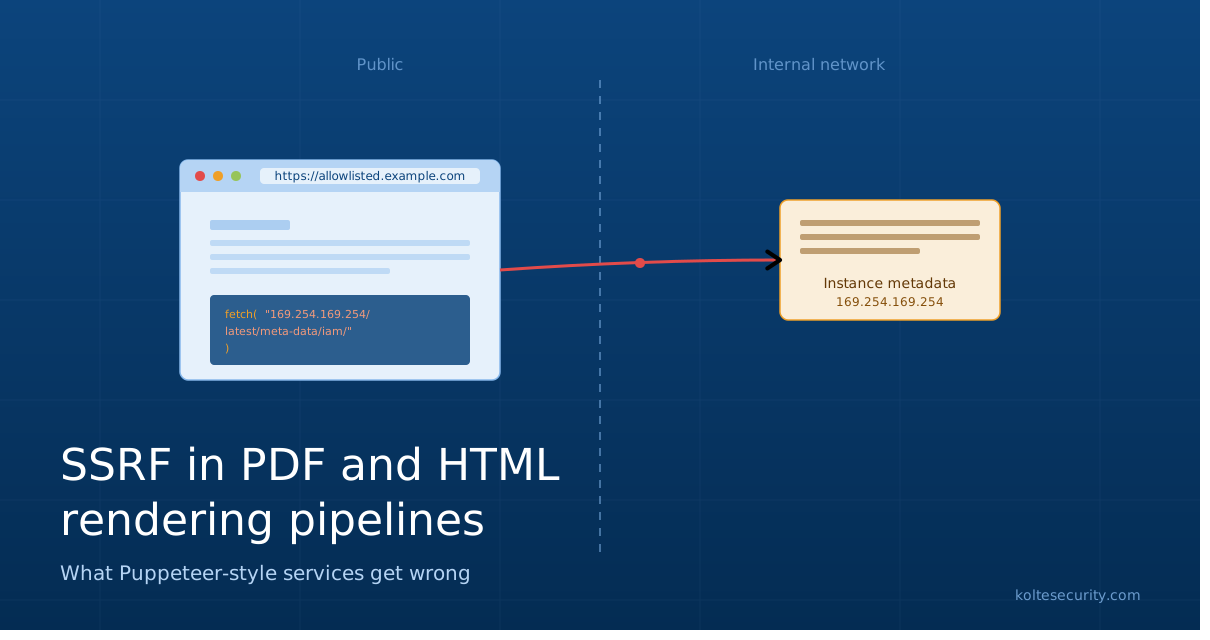
When people talk about SSRF, they usually picture a backend service fetching a user-supplied URL. A profile picture fetcher, a webhook validator, a link unfurler. The mental model is a single HTTP request leaving your network and going somewhere it should not.
Headless browser renderers break that mental model.
A Puppeteer, Playwright, or Chrome-headless service does not make one request. It loads a page, executes JavaScript, follows redirects, fetches subresources, and can be steered by the page itself into making requests the operator never imagined. You are not exposing an HTTP client to user input. You are exposing a full browser.
And anything that runs JavaScript on attacker-controlled content is a much bigger attack surface than most teams model.
Where these renderers show up
Generate a PDF from a template. Render a screenshot for a preview card. Convert a customer report into a printable format. Most of these features start as a small internal tool and end up in production with real customer input flowing through them.
The renderer almost always runs server-side, inside your VPC, often with no egress controls, and frequently with more network reachability than the application that invoked it. It is, by design, a service that fetches things on your behalf — which is the textbook definition of an SSRF sink.
What makes browser-based SSRF different
Three things make headless renderers harder to reason about than a typical SSRF.
First, the request surface is huge. A single page load can produce dozens of subrequests. Filtering the top-level URL does almost nothing.
Second, JavaScript executes. Even if you sanitize the input URL, the page returned by that URL can issue fetch calls, create iframes pointing at internal hosts, or use redirects to pivot. Your allowlist applied to the entry URL is irrelevant once the renderer is parsing attacker HTML.
Third, the renderer has its own attack surface. It is a browser, and browsers get CVEs.
How I think about renderers during security reviews
When I review a feature that uses a headless browser, I work through the same questions every time.
What input reaches the renderer, and from which trust boundary?
What can the renderer reach on the network? If the answer is "everything in the VPC," that is the headline finding before you read another line of code.
What happens after the first request? Are redirects followed? Are subresources loaded? Is JavaScript execution required, or is it on by default because nobody turned it off?
What identity does the renderer carry? Instance metadata credentials, a service account, cookies from a shared domain? Each one is an exfiltration channel if the renderer can be steered.
How is the output handled? PDFs and screenshots can embed content from internal pages the renderer was tricked into loading. The output channel is part of the SSRF surface, not separate from it.
Defensive practices that actually help
The single highest-leverage control is network posture. Run the renderer in a separate segment with an explicit egress allowlist. Block link-local and private address ranges at the network layer, including IPv6 equivalents. Application-layer checks miss DNS rebinding; network-layer checks do not.
Treat input URL allowlists as defense in depth, not as the primary control. They get bypassed through redirects and open-redirect chains on otherwise-trusted domains.
Disable JavaScript by default and turn it on only for features that demand it. A surprising number of PDF generation features render static templates and could run with JS off entirely.
Strip instance metadata access from the renderer host. On AWS, that means IMDSv2 with a hop limit of 1 at a minimum.
Log every outbound request the renderer makes, not just the input URL. Without this, you cannot tell the difference between a feature working and a feature being abused.
A short example
Consider a feature that renders a user-supplied URL to PDF. The team has been careful: input URL is allowlisted, renderer runs in a container, 30-second timeout.
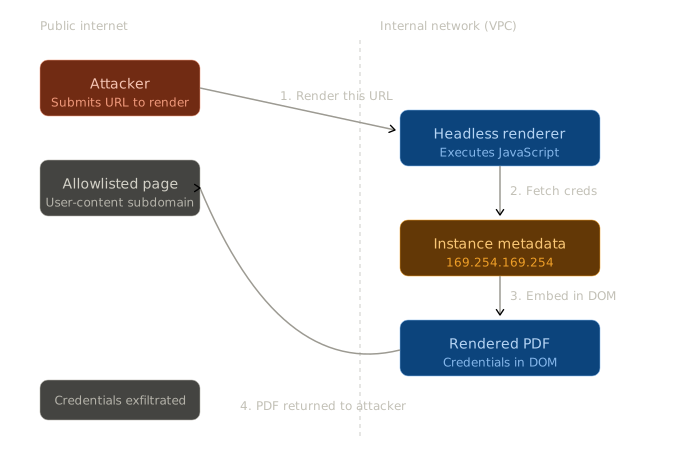
An attacker hosts a page on an allowlisted domain — perhaps through a user-content subdomain. The page passes the check. The renderer fetches it and runs its JavaScript. The page fetches http://169.254.169.254/latest/meta-data/iam/security-credentials/ and embeds the returned credentials into the DOM. The renderer produces a PDF and returns it to the requester.
The allowlist did nothing. The timeout did nothing. The container did nothing. Only network egress controls, IMDSv2, and disabled JavaScript would have stopped this.
The bigger picture
Headless renderers are one example of a pattern I keep seeing in modern AppSec. The interesting attack surface is no longer the application code. It is the supporting service it calls, running in a network position that the application team never considered, with capabilities nobody documented. The same shape shows up with image processors, document converters, and AI tool-calling backends.
When I review one of these features, I do not start with the code. I start with the network diagram. Because in this class of vulnerability, the network posture is the security posture. Everything else is defense in depth.